2026-10-09
What They Took From Us. What They Could Never Take From Us.
These two paintings began with my photographs of Appeal to the Great Spirit, the sculpture by Cyrus Dallin outside the Museum of Fine Arts, Boston.
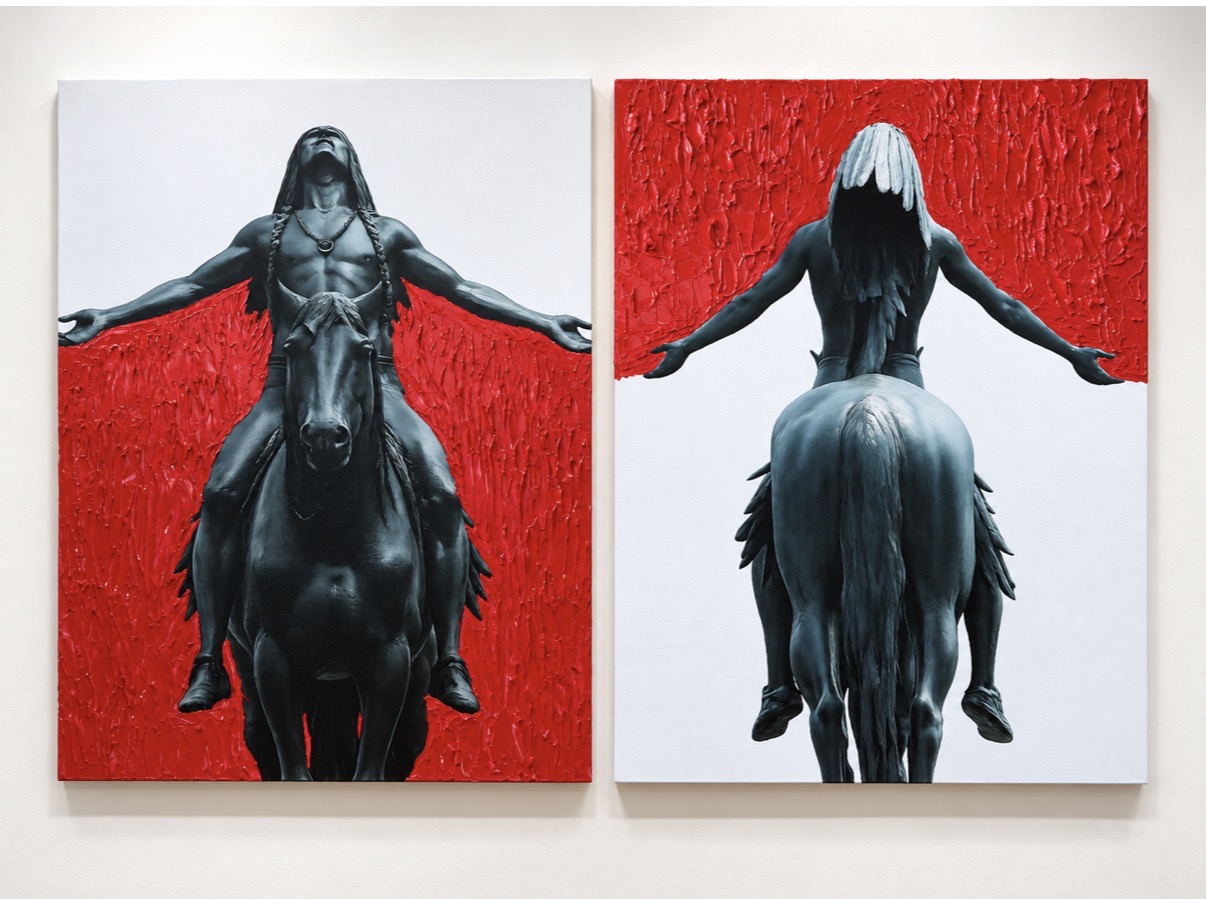
A figure on horseback, arms extended, face lifted. I photographed it from the front and from behind. Those two perspectives became the foundation for What They Took From Us and What They Could Never Take From Us.
Together, they ask a question that reaches beyond the canvas: What remains when people try to take away everything that makes you who you are?
As an Alabama artist with Cherokee ancestry, this history carries personal weight. My ancestral ties to the Cherokee people are part of why I feel compelled to look closer, learn more, and make work that holds difficult questions. That connection gives me a responsibility to approach the subject with care and to recognize the distinct histories of Indigenous peoples.
The sculpture itself is not a portrait of my Cherokee ancestors. It is the starting point for my own response to Indigenous representation, cultural loss, and survival.
What They Took From Us faces the viewer. The red rises from the bottom of the canvas and meets the outstretched arms. For me, that red carries the weight of dispossession: land taken, families separated, and the pressure placed on people to surrender their identity to survive.
Here in the Southeast, Cherokee history belongs to the very ground beneath our feet. The Cherokee homeland included parts of what is now Alabama, along with Georgia, Tennessee, and North Carolina. Forced removal uprooted people from those homelands, sending them west on the journeys remembered as the Trail of Tears. It was the loss of homes, communities, familiar landscapes, and places where generations had built their lives.
And removal was only part of the story.
Forced assimilation reached into families and into childhood. Native American boarding schools separated Indigenous children from their communities and sought to replace their languages, customs, and identities. Children were punished for speaking their own languages. The demand was to become someone else, according to someone else’s definition of civilization.
Assimilation is a tidy word for something that can leave a very untidy wound. It asks what happens to a family when belonging comes at the price of silence. What gets passed down? What becomes difficult to name? What does the next generation have to search for?
Those questions sit inside this work.
In What They Could Never Take From Us, the figure turns away. We see the back of the rider and the horse, with the red now above the arms. The same posture takes on a different feeling. I read strength in that back, a presence that continues beyond our view.
The reversal matters. One painting confronts the viewer. The other asks the viewer to follow.
Across both canvases, the textured red interrupts the photographic image. It has ridges, scars, and places where the surface refuses to settle. Working in mixed media lets me bring that physical resistance into the paintings. The photograph records a sculpture. The painted surface carries my response.
The second title holds a conviction, but it also holds a question. There were devastating losses. Survival does not undo them. Yet Indigenous peoples continue to sustain communities, protect their cultures, and determine their futures.
I wanted to leave room for that living presence.
My Cherokee ancestry brings these questions closer to home. It makes me consider what I have inherited, what I still need to understand, and how an artist can approach ancestral memory honestly. I cannot paint the whole history into two canvases. I can make something that asks us to stop long enough to consider it.
These paintings belong together because loss and endurance belong in the same conversation. Each changes how we see the other.
I keep returning to those open arms. There is vulnerability in them. There is grief. And there is a figure who still occupies space.
Still present. Still asking us to look.
What They Took From Us and What They Could Never Take From Us Mixed media incorporating my original photographs of Cyrus Dallin’s Appeal to the Great Spirit 30 × 40 inches each